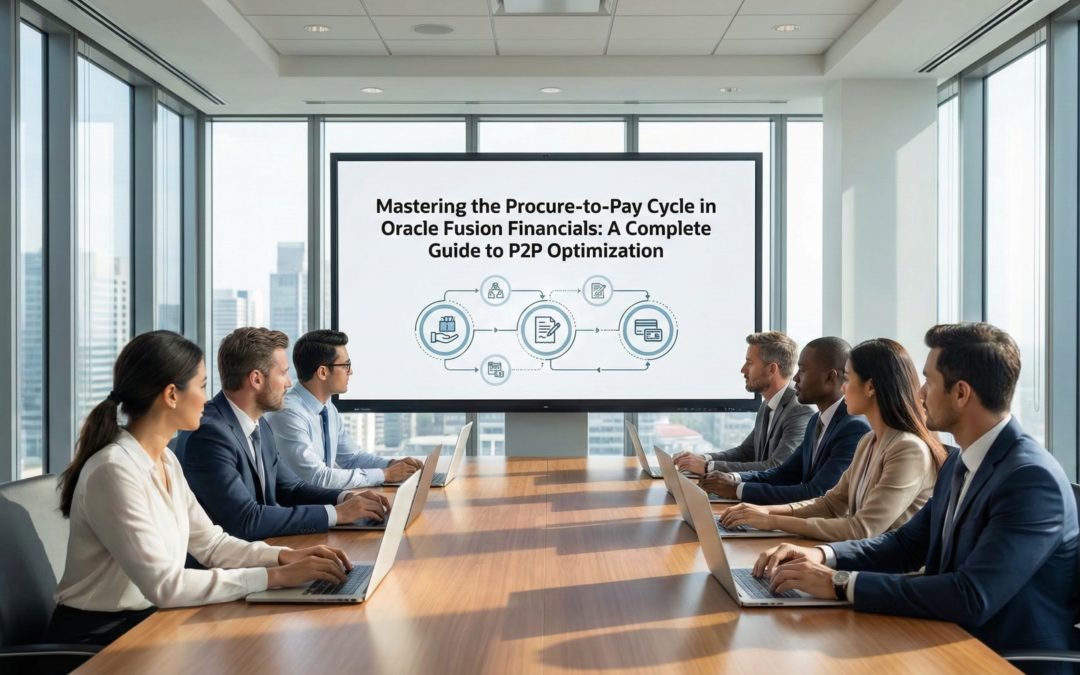
💼 The Procure-to-Pay (P2P) cycle represents one of the most critical financial processes in any organization, and Oracle Fusion Financials delivers a comprehensive, integrated platform to manage this end-to-end workflow with unprecedented efficiency and control. For finance leaders and Oracle practitioners, understanding how to optimize each stage of the P2P cycle—from initial requisition through final payment—is essential for achieving operational excellence, maintaining compliance, and driving strategic value.
🎯 At its core, the P2P cycle encompasses the complete journey of procurement activities: requisitioning goods and services, creating and approving purchase orders, receiving and inspecting deliveries, processing supplier invoices, and ultimately disbursing payments. Oracle Fusion Financials seamlessly integrates these functions across Procurement, Inventory, Accounts Payable, and Cash Management modules, creating a unified data model that eliminates redundant data entry and ensures consistency throughout the process.
The Requisition-to-Order Process
🔄 Every P2P cycle begins with a business need. In Oracle Fusion Procurement, employees create purchase requisitions to formally request goods or services. These requisitions capture essential details including item descriptions, quantities, required delivery dates, suggested suppliers, and cost center allocations. The requisition process provides the foundation for spend visibility and budget control, allowing organizations to track demand patterns and enforce purchasing policies before commitments are made.
📋 Requisitions flow through configurable approval workflows based on business rules such as amount thresholds, commodity categories, or organizational hierarchies. Oracle’s BPM (Business Process Management) workflows enable sophisticated routing logic that can include parallel approvals, escalations, and automatic notifications. Once approved, requisitions convert into purchase orders that formalize the legal commitment with suppliers.
📦 Purchase orders in Oracle Fusion contain comprehensive information including line-level details, pricing agreements, payment terms, delivery schedules, and shipping instructions. The system supports various PO types including standard orders, blanket agreements, contract purchase agreements, and planned orders. Importantly, all data captured at the PO level—including supplier details, tax classifications, and account distributions—automatically flows downstream to receiving and invoice processing, eliminating manual re-entry and reducing errors.
Receipt and Inspection Management
📍 The receiving process serves as a critical control point in the P2P cycle, confirming that ordered goods have been delivered in acceptable condition and correct quantities. Oracle Fusion enables receipt creation through multiple channels: directly by receiving personnel through the mobile or web interface, automatically through integration with warehouse management systems, or via supplier advance shipment notices.
✅ Receipts capture essential information including received quantities, inspection results, quality holds, and location details. For organizations using Oracle Cost Management, the receipt transaction triggers cost accounting entries that value inventory at the appropriate cost. The system supports accrue-on-receipt accounting, where expense recognition occurs at the time of receipt rather than invoice approval—providing more accurate period-end accruals and financial reporting.
🔍 Oracle Fusion’s matching capabilities allow invoices to be matched directly to receipts rather than just purchase orders. This approach offers significant advantages: it prevents invoice holds when paying for partial shipments, reduces foreign exchange variances by shortening the time between the triggering event and invoice, and ensures tighter correlation between physical receipt and financial obligation. For organizations using periodic costing methodologies, matching to receipts is critical for accurate cost accounting and margin analysis.
Supplier Management and Master Data
🤝 Effective supplier management provides the foundation for smooth P2P operations. Oracle Fusion maintains comprehensive supplier profiles that include corporate hierarchy, site-level configurations, banking details, tax registrations, and relationship classifications. The supplier master data architecture distinguishes between suppliers (legal entities) and supplier sites (locations), enabling organizations to manage complex supplier relationships with multiple invoicing, payment, and procurement locations.
⚙️ At the supplier site level, organizations configure critical defaults that govern invoice processing and payment execution. These include payment terms that define due date calculations and available discount structures, payment methods specifying how funds should be transmitted, invoice matching requirements, and tolerance levels for acceptable variances. Well-configured supplier master data reduces exception handling and accelerates invoice processing by ensuring invoices arrive with appropriate attributes and processing rules.
🌐 Oracle Fusion’s supplier portal extends P2P capabilities directly to trading partners, enabling self-service invoice submission, payment inquiry, purchase order acknowledgment, and document exchange. This collaborative approach reduces administrative burden on internal teams while improving supplier satisfaction through increased transparency and faster resolution of discrepancies.
Invoice Processing and Matching
🧾 Invoice processing in Oracle Fusion Accounts Payable leverages multiple ingestion channels to accommodate diverse supplier preferences and document formats. Organizations can receive invoices through email with Intelligent Document Recognition (IDR) for AI-powered data extraction, EDI transactions for automated B2B integration, the Supplier Portal for web-based submission, or manual entry for exception scenarios.
🤖 The Intelligent Document Recognition capability uses machine learning models trained on invoice patterns to automatically extract key fields including supplier information, invoice numbers, dates, line-item details, tax amounts, and totals. IDR continuously improves accuracy through feedback loops, reducing manual intervention and accelerating processing cycles. Extracted invoices route through validation processes before being created in the system.
🔗 Matching represents the core control mechanism that ensures organizations pay only for goods and services that were ordered, received, and priced correctly. Oracle Fusion supports multiple matching types including two-way matching (invoice to purchase order), three-way matching (invoice to purchase order and receipt), and four-way matching (adding inspection acceptance). Organizations configure matching requirements based on commodity risk, supplier relationships, and internal control policies.
💡 During the matching process, Oracle Fusion automatically creates invoice lines using information from purchase order schedules and generates invoice distributions based on PO distribution details. The system updates billed quantities and amounts on source documents, maintaining accurate open commitment balances for procurement and budget tracking. When an invoice matches to a PO schedule with multiple account distributions, matched amounts are automatically prorated across all distributions according to the defined allocation percentages.
⚖️ Invoice tolerances determine whether matching holds are placed on invoices when variances exist between the invoice and matched documents. Organizations configure tolerance rules at multiple levels—supplier site, item category, or system default—specifying acceptable variance percentages or absolute amounts for price, quantity, and total. Invoices exceeding tolerance thresholds are held for review, while those within acceptable ranges proceed to approval workflows automatically.
Variance Management and Accounting
📊 When invoice prices differ from purchase order prices, Oracle Fusion generates variance distributions to account for the difference. The accounting treatment of these variances depends on the accrual method and item type. For inventory items with accrue-on-receipt accounting, price variances post to variance accounts defined in the item’s costing setup, ensuring that inventory remains valued at standard cost while price differences are isolated for analysis.
💵 For expense items or services, variance handling depends on organization policy. Some organizations absorb small variances into the original expense account, while others route variances to dedicated variance accounts for procurement performance analysis. Oracle Fusion provides flexibility in variance account configuration, supporting both centralized and distributed variance tracking approaches.
🔄 The system also handles complex matching scenarios including matching invoices to receipt charges for freight and miscellaneous costs, matching to consumption advice documents for consigned inventory that has been consumed, and matching to purchase order lines with supplier credits where trade-ins or returns offset new purchases. These capabilities ensure that invoice processing accommodates real-world procurement scenarios while maintaining accurate cost accounting.
Approval Workflows and Validation
✍️ Before invoices are validated for payment, they flow through approval workflows based on configurable business rules. Oracle Fusion enables organizations to design approval routing based on invoice attributes such as amount thresholds, account distributions, supplier classifications, or custom criteria. Workflows can include sequential or parallel approvals, automatic escalations for overdue items, and delegation capabilities for approver absences.
🛡️ The validation process performs comprehensive checks to ensure invoice accuracy and compliance. The system verifies that required fields are populated, matching has been completed within tolerances, tax treatments are correctly applied, accounting distributions balance and use valid accounts, and any required approvals have been obtained. Invoices failing validation are placed on hold with detailed explanations, allowing AP teams to efficiently identify and resolve issues.
🔐 Oracle Fusion supports multiple hold types including system-automated holds for matching variances or validation failures, and user-manual holds for specific business reasons such as disputed charges or pending supplier resolution. Hold management capabilities enable AP teams to monitor aging, track resolution responsibility, and report on exception trends for process improvement initiatives.
Payment Controls and Disbursement
💰 Once invoices are validated and approved, they become eligible for payment processing. Oracle Fusion Payments manages the disbursement cycle through payment process profiles that serve as blueprints defining how payments are built and executed. These profiles specify critical parameters including payment document grouping rules, payment methods and formats, transmission protocols, and payment validation requirements.
🎛️ Payment process profiles control how documents payable (validated invoices) are grouped into individual payments. Organizations can configure grouping based on attributes such as supplier, supplier site, currency, payment terms, business unit, or custom criteria. Proper grouping logic optimizes payment efficiency while accommodating supplier preferences and banking constraints such as maximum payment amounts or transaction limits.
📝 The payment process request allows AP teams to define selection criteria for the payment run, specifying parameters such as payment date, due date range, supplier scope, business units, and payment method filters. Oracle Fusion evaluates documents payable against these criteria, applying payment grouping rules and generating a proposed payment batch for review before final execution.
🔒 Payment validation provides a final control checkpoint before funds are disbursed. The system verifies that invoice distributions have been accounted and posted, supplier banking information is complete and active, payment amounts don’t exceed available balances if funds checking is enabled, and all required approvals have been obtained. Payments failing validation are set aside with detailed error messages for resolution.
💳 Oracle Fusion supports diverse payment methods including electronic funds transfer (EFT/ACH), wire transfers, checks, payment cards, and third-party payment platforms. Each payment method can be configured with specific formats, file layouts, and transmission protocols. The system generates payment files in the required format for banking integration and maintains comprehensive audit trails of payment creation, modification, and transmission activities.
Integration and Financial Reporting
🔗 A key advantage of Oracle Fusion’s P2P cycle is the seamless integration with General Ledger and other financial modules. As transactions progress through the P2P workflow, the system automatically generates accounting entries based on subledger accounting rules. Receipt transactions create inventory or expense accruals, invoice approvals record liabilities, and payment execution clears those liabilities while recording cash disbursements.
📈 The Subledger Accounting engine provides flexible accounting rule configuration, enabling organizations to implement complex accounting treatments such as multi-currency accounting with realized gain/loss calculation, intercompany transaction accounting with automatic eliminations, project or grant costing with specialized accounting, and industry-specific accounting requirements. All accounting entries maintain full drill-back capability to source documents, supporting audit and investigation requirements.
📊 Oracle Fusion delivers comprehensive reporting and analytics across the P2P cycle. Standard reports cover invoice aging analysis, payment forecasting and cash requirement planning, supplier spending and performance metrics, matching exception trending, and procurement commitment tracking. The platform’s embedded analytics enable self-service exploration of P2P data, allowing users to create custom dashboards and perform ad-hoc analysis without IT intervention.
Best Practices for P2P Optimization
🎯 Organizations seeking to optimize their P2P cycle in Oracle Fusion should focus on several key areas. First, invest in comprehensive supplier master data management with accurate configurations for payment terms, tax classifications, and tolerance settings. Clean supplier data prevents downstream exceptions and accelerates processing velocity.
⚡ Second, maximize automation through Intelligent Document Recognition, electronic invoice receipt channels, and exception-based workflows that focus human attention on items requiring judgment while allowing routine transactions to flow through automatically. The goal is straight-through processing for the majority of invoices, with only true exceptions requiring manual intervention.
🔍 Third, implement robust matching controls appropriate to risk levels. High-value or high-risk purchases should require three-way matching with tight tolerances, while low-risk, low-value transactions might use two-way matching or even invoice-only processing to reduce administrative burden. Regularly review tolerance settings to ensure they reflect current market conditions and supplier performance.
💬 Fourth, foster supplier collaboration through the supplier portal and proactive communication about invoice requirements, payment schedules, and issue resolution. Suppliers who understand your invoice processing requirements and have visibility into payment status are less likely to generate exception invoices and more likely to resolve discrepancies quickly.
📉 Fifth, continuously monitor P2P metrics and use analytics to identify bottlenecks, exception root causes, and improvement opportunities. Key performance indicators should include invoice processing cycle time, matching exception rates, payment discount capture, early payment discount utilization, and cost per invoice processed. Regular process reviews with cross-functional teams from procurement, receiving, and accounts payable ensure alignment on improvement priorities.
🚀 By leveraging Oracle Fusion Financials’ integrated P2P capabilities—from requisition through payment—organizations can achieve significant benefits including reduced processing costs through automation, improved cash flow management with accurate payment forecasting, stronger supplier relationships through transparency and timely payment, enhanced compliance with matching controls and audit trails, and better financial visibility through real-time reporting and analytics. The key to success lies in thoughtful configuration, disciplined master data management, and continuous process optimization based on performance metrics and user feedback.